Residents of Kabada, Nitrain Community in Sinoe County, are calling on Golden Veroleum Liberia (GVL) to take urgent steps to address what they describe as worsening environmental and public health conditions linked to the company’s oil palm operations.
They outlined three key demands: the replanting of forests destroyed during oil palm expansion, the provision of safe drinking water, and immediate action to control what they described as a growing swine of flies in the area.
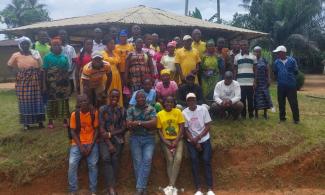
The residents spoke on February 17, 2026, during a meeting organized by the Sustainable Development Institute (SDI) aimed at assessing whether Golden Veroleum Liberia (GVL) has complied with the mandate issued by the High Carbon Stock Approach (HCSA) to replant 1,000 hectares of forest areas destroyed by GVL in 2018.
In 2021, HCSA, a multi-Stakeholder initiative aimed at protecting forests, determined that GVL had destroyed 1,000 hectares of the Upper Guinea Forest, an at-risk ecosystem home to rural communities and endangered species, including chimpanzees and pygmy hippos.
The residents recounted that large portions of their customary forest were cleared during the company’s expansion activities, significantly affecting their livelihoods and traditional way of life. “We depend on our forest for farming, hunting, and traditional medicines. Our forest must be replanted,” one elder said.
Beyond deforestation, the residents expressed serious concern about water quality. According to them, creeks and rivers that once served as primary sources of drinking water have become polluted. “Our creeks used to provide clean water. Now the water is dirty, and we are afraid to drink it. We need safe drinking water for our children,” one community member insisted
Another major concern raised by the community is what residents described as a “swine of flies” that has become a daily trouble. They believe the problem is linked to waste management practices associated with the oil palm plantation. “The flies are everywhere in our homes, on our food. This is not healthy for our people,” a community member said.
Speaking to cross section of citizens at the end of the meeting, they expressed frustration, but emphasized their willingness to engage in constructive dialogue with the company and relevant government authorities. They called for immediate intervention to address the environmental and health challenges facing Kabada and the Nitrain community at large
“We are not against development. But development must not destroy our environment or endanger our lives,” another community said.
A member of the Nitrain Youth Association acknowledged some of the good things the company has been providing, but said, “We are affected. Our creeks are damaged because no safe water from our creeks. We used to go to the creeks to swim and do other things, but everything is damaged. The chemicals are also affecting us, such as rashes, flies, among others. The company needs to do the right things by replanting our forests because the forests help us a lot. We live in the forest because it gives us oxygen, and its destruction means no good living for us.”
Also speaking, another also praised the company for some efforts, but said more needs to be done. He said, “For safe drinking water, I can grade them 30% because since they came they have renovated hand pumps once, but they have gone down and the communities been complaining. Their destruction of the forests has greatly affected the creatures that once lived in these forests and are now living with us in the communities. There are more flies, and their clinic only caters to their workers. The company needs to replant our forests and repair our hand pumps. They also need to tell us the land space they are occupying.”
At the same time, a member of the Community Forest Management Body (CFMB) of the Nitrain Community, said, “There are some areas in the concession where the chimpanzees used to come due to the encroachment of the forests. They are yet to do reforestation after destroying our forest.”
Sampson M. Williams, National Program Assistant at SDI, reaffirmed the organization’s commitment to ensuring that affected communities are heard and that corporate actors, including GVL, are held accountable to environmental and human rights obligations.
The activity was supported by the Green Livelihoods Alliance (GLA) forest for a just future programme, Milieudenfensie, through the Dutch Ministry of Foreign Affairs. It is now being supported by Friends of the Earth USA to continue such engagements
Meanwhile, citizens say they remain hopeful that their calls will be met with swift and concrete action.